EU-TRACK
Gravel site roads
Gravel or mats?
Site roads: build-up, removal and the alternative
A gravel site road is quickly ordered, but laborious to build and to remove again. Ground protection mats are laid in minutes, picked up again and move on to the next site.
How a gravel road is built
The usual build-up
- Strip the topsoil and store it at the side
- Lay a geotextile: it separates gravel and soil
- Build the gravel base course, grading about 0/32 to 0/45, in layers of at most 25 cm
- Compact every layer and test the bearing capacity with a plate load test
For wind farm access roads, turbine makers require at least 25 cm of gravel on a 4 m wide carriageway. Our calculator uses 40 cm as its default.
Removal
What is left after the site
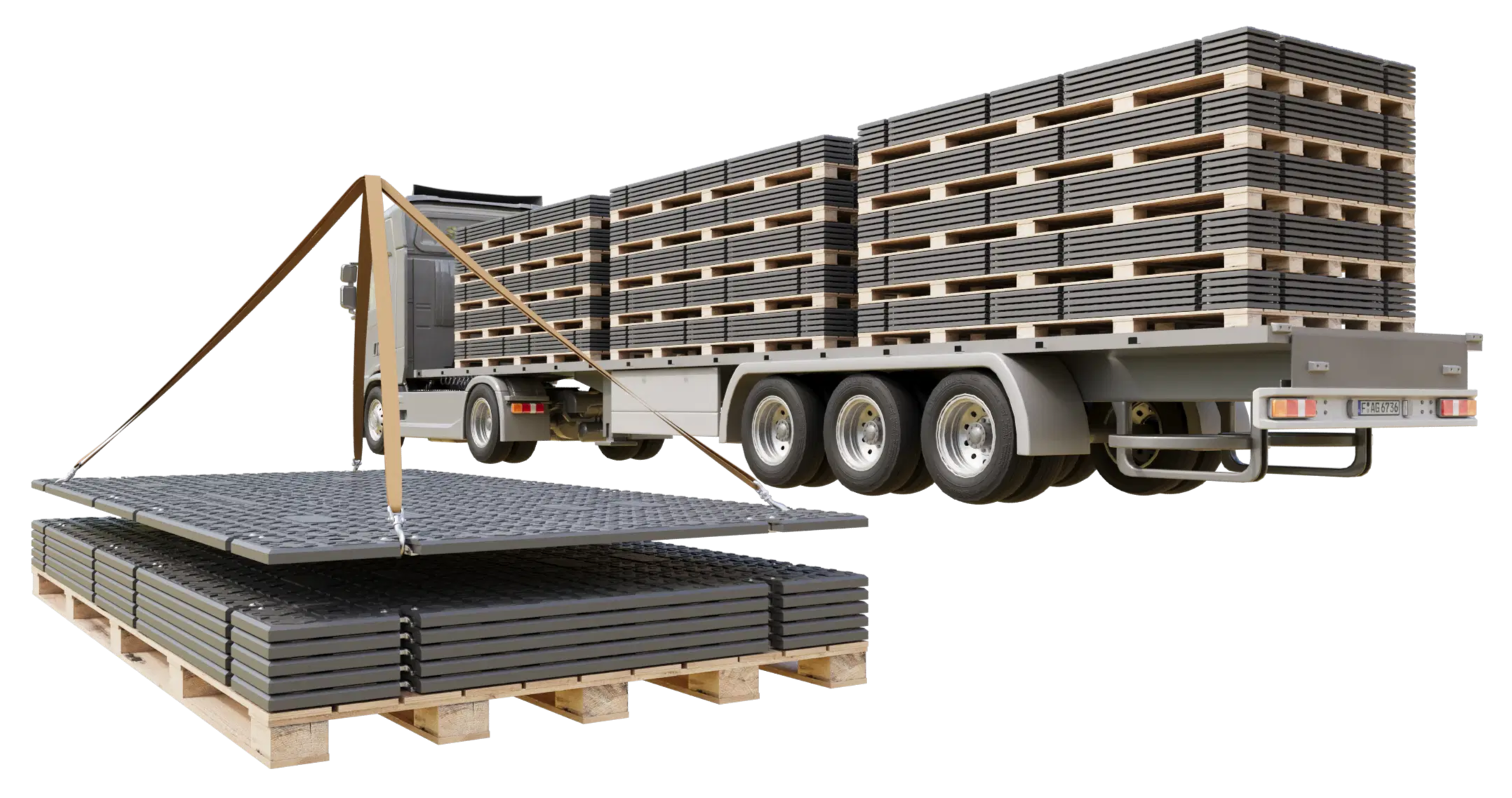
- Dig out the gravel and haul it away
- Loosen the soil down to the depth of compaction
- Restore the soil functions: for wind turbines, site roads must be removed at the latest when operation ends
Mats are picked up, loaded and reused. Authorities name mat systems explicitly as a measure against soil compaction.
The comparison
100 m of site road, 4 m wide
What does your road cost?

The cost of a gravel road depends on length, width, layer thickness, ground and disposal. Our calculator compares gravel, steel plates and EU-Track for your project: cost, CO₂ and working time, with every assumption shown.
To be fair
When gravel is the better choice
Frequently asked questions
How thick must the gravel layer of a site road be?
That depends on the ground and the loads and is assessed on site. For wind farm access roads, turbine makers require at least 25 cm; our calculator uses 40 cm as its default.
Which grading is used for a site road?
Usual are gravel mixes of grading 0/32 to 0/45, built in layers and compacted.
Does a gravel road need a geotextile?
A geotextile under the gravel is usual. It separates gravel and soil, so less gravel is lost in the ground and removal is easier.
How many truckloads of gravel does a site road take?
For 100 m length, 4 m width and 40 cm thickness, about 288 t of gravel, some 12 loads of 25 t. Removal takes as many trips again.
Does a site road have to be removed?
Usually yes. For wind turbines, site roads and crane pads must be removed at the latest when operation ends and the soil functions restored. After the gravel is removed, the soil is loosened.
What does a site road cost per m²?
The cost depends on length, width, layer thickness, ground and disposal. Our calculator compares gravel, steel plates and mats for your project.